Social Icons


Showing posts with label gifted education. Show all posts

Friday, May 6, 2016

Definition of Giftedness

The following represent a variety of definitions of "giftedness":

Giftedness is asynchronous development in which advanced cognitive disabilities and heightened intensity combine to create inner experiences and awareness that are qualitatively different from the norm. (The Columbus Group, 1991)


The term "gifted and talented students" means children and youth who give evidence of high performance capability in areas such as intellectual, creative, artistic, or leadership capacity, or in specific academic fields, and how require services or activities not ordinarily provided by the school in order to fully develop such capabilities. (US Congress revision of the Maryland report of 1972 in 1988 - P.L. 100-297, Sec. 4103, Definitions)

Sternberg's five "necessary and sufficient conditions that gifted persons have in common":
  1. Excellence: A gifted person must be extremely good at something.
  2. Rarity: He or she must posses a high level of an attribute that is uncommon relative to peers.
  3. Productivity: The superior trait must (potentially) lead to productivity.
  4. Demonstrability: The trait also must be demonstrable through one or more valid tests.
  5. Value: The superior performance must be in an area that is valued by society.
(Davis and Rimm, 1998, p.23)


Joseph Renzulli's Three-Ring Model


"Gifted behavior...reflects an interaction among three basic clusters of human traits - these clusters being above average (but not necessarily high) general and/or specific ability, high levels of task commitment (motivation), and high levels of creativity. Gifted and talented children are those possessing or capable of developing this composite set of traits and applying them to any potentially valuable area of human performance." (quoted in Davis and Rimm, 1998, p. 19)

What is your definition of giftedness?


Thursday, May 5, 2016

Creativity and Problem Solving


In the pursuit of "STRETCh'ing" student learning and meeting the needs of those students who are ready for the "Next STEP", The Center for Creative Learning has a wealth of resources for helping to engaged talented problem solvers. Many times students who are talented in the area of acquiring content knowledge quickly become disengaged with school out of boredom.

As schools shift to meeting the needs of 21st century learners, you will see more brain-based strategies and problem-solving application of content assessments.


Wednesday, May 4, 2016

Center for Gifted Education College of William and Mary

I found the following document that is an individual instruction plan "Menu" for the gifted child.


The vast majority of items on the list seem to be good for ALL children. I think programming for the gifted is not as simple as this list makes out.

With gifted students it is the asynchronous learning that needs to be accommodated for! 


It is not a one size fits all. The above model is not account for the asynchronous learning either. Tier 4 should be available as needed - not after formal identification.

As parents, you need to be armed with this information! If your child is great at Geometry and is working above grade level in that area only, you have a right to ask for their learning to be differentiated.

Saturday, December 6, 2014

"But I Don't Want To Be Gifted!"

I came across this article in an old binder and would love to give credit to the author; however, I have searched with numerous key words and have not been able to locate where the article came from. If you know...please contact or comment so that I can give credit to the appropriate person on entity that created this wonderful article!

While I definitely do not agree with everything in the article, there are aspects that hit home with the STRETCh philosophy. If we focus on the "next steps" with students, rather than a product they must produce  - everyone will go further and we will push each other as a society! We need to take the fear out of failure and focus creating young scholars who are engaged in learning and can preserver when things become difficult!

Here is the document - retyped so that it is legible :-)

There it is - a file folder full of potential: high IQ scores, graphs and charts with marks to indicate the ninety-ninth percentile, I.E.P's (Individual Education Plans), computer readouts, teacher checklists, parent checklists, and even student checklists. It's all there, all the "right" data - proof positive that this child is gifted. So what's the problem?


As we dig deeper into this maze of numbers, points and scores, the inconsistencies begin to surface. There are report cards with roller coaster grades, everything from straight A's to D's. There are hand-written notes from f r u s t r a t e d teachers and parents: 

  • "This child is bright, but he has such poor handwriting." 
  • "She isn't working up to her potential,  doesn't seem to be motivated." 
  • "He deliberately failed a history test, even though he knew all the answers." 
  • "She really seems to enjoy math but is so slow at getting her other work finished." 
  • "He is such a perfectionist."
  • "She has a poor attitude about herself and school."
  • "He asked to be removed from the gifted program. No reason given."
image from original article

And so it goes. This folder full of potential reads like a war diary, a chronicle of battles, some won, some lost. We find one problem after another, one recommendation after another, all in the name of education.

IS IT ANY WONDER...?

The word is gifted - a six-letter word that makes some gifted children cringe. Why? First, it is definitely a learned attitude, most often from adults. Parents who hesitate to admit in public that their child is gifted are sending a message to their child that giftedness may be something of which to be ashamed. School administrators do the same thing when they attach vague, cute titles to gifted programs. (Call the program anything, but just don't use the word gifted!) Instead of pride and confidence in establishing a program that meets the needs of certain students who happen to be gifted, there is fear and resentment - fear that such a program will "stir up" community resentment toward gifted students because they don't deserve a special program. Some classroom teachers reinforce the "gifted is a bad word" philosophy when they constantly remind gifted children of their weaknesses. They condition gifted children into being average or into thinking they are average. Parents and educators have a tendency to withhold praise from gifted children because they expect them to do superior work. They have mistaken the idea that gifted children don't need as much praise and reinforcement as other children. Is it any wonder that gifted children so quickly develop a resentment toward giftedness?

  • "It wouldn't be so bad if I didn't have to be gifted all the time." (Bryan, Age 5)
  • "Giftedness is not something you earn." (Dr. Walter Barbe)
  • "It ain't easy being green." (Kermit the Frog)
Bryan, Walter, and Kermit are extraordinary philosophers. They know. They understand what it means to be different. The pressure placed upon gifted children by parents, teachers, and society in general must seem unbearable at times. Dr. Judy Roseberry, Unified School District, Garden Grove, California, also understands. She h as responded to the pressures with the following:

Premises of the Demands of Giftedness:
  • High level intelligence makes certain demands upon the gifted child.
  • Behavior of gifted children results from these demands.
  • There are curriculum implications inherent in these demands.
A gifted child's behavior often reflects the following demands:
  • To crave knowledge, to satisfy the need to feel progress in what he/she is learning.
  • To feel the need to focus on or devour a subject.
  • To make observations, to see relationships.
  • To place high standards on himself/herself.
  • To be creative or inventive, to seek an unusual or unique approach to an assignment.
  • To question generalizations.
  • To be serious-minded, to be intolerant (usually) of foolishness or silliness.
  • To concentrate, to become totally absorbed in a task, to have a longer attention span.
  • To explore wide interests at a maturity beyond his/her chronological age.
  • To be sensitive to honor and truth.
  • To express ideas and reactions (sometimes being seen as argumentative).
  • To resist routine, drill; to require unique ways of pursuing drill.
  • To work alone.
  • To be intolerant of stupidity.
  • TO seek order, structure, consistency.
  • To do critical evaluative thinking (possibly leading to a critical attitude toward self and others).
  • To be rarely satisfied with the simple and obvious.
  • To be impatient with sloppy or disorganized thinking.
  • To have his/her intelligence responded to.
  • To seek out his/her mental peers.
  • To be friendly and outgoing.
  • To use his/her power of abstraction, to see and point out cause and effect relationships.
  • To have time for thinking, solitude.
  • To pursue a learning pace of his/her own.
  • To be outstanding in many areas but average in others.
As difficult as these demands may be for parents and educators to respond to, just imagine what it would be like to live with them every single day. Is it any wonder...?

Problem: In many schools gifted students must leave the regular classroom in order to participate in a gifted program. In some of these pull-out programs, the gifted students are forced to do twice as much paperwork because they are required to make up the work they miss in the regular classroom, as well as complete the work in the gifted program. In effect, they are being punished for being gifted.

Solution: Gifted students should be held responsible for the learning they are missing in the regular classroom but not necessarily for the work. Classroom teachers can administer pretests or posttests that can easily determine whether a gifted child has already mastered a skill.
  • Problem: Some parents use their gifted children as social status symbols. They impose unrealistic goals and expectations on their children, which can result in feelings of inadequacy accompanied by fear of failure.
  • Solution: Membership in an organization for parents of gifted students can be very helpful in raising the awareness level of parents who may be putting too much pressure on their gifted children. The interaction with other parents of gifted children is very effective. In addition, school counselors, gifted program coordinators, and/or psychologists should also be involved in solving this problem - the sooner, the better!
Problem: A gifted child may withdraw into a private shell if he/she is not being challenged. Since the gifted are capable of divergent thinking, they may feel their own responses are wrong because they fall outside the realm of what is generally accepted. They need to see themselves as part of a whole society.

Solution:  Finding a mentor for a gifted child offers a unique form of individualized instruction and self-directed learning. A mentor can help a student explore his strengths and weaknesses while improving his understanding of the relationship between school and the outside world. "Mentoring is the gifted tutoring the gifted, and underlines the importance of their being one of their own, as well as society's, best resources for realizing learning potentials." (Runions, 1980)

  • Problem:  Sometimes gifted children suffer verbal abuse from children who are not gifted. As a result, many gifted children will go through phases of trying to hide their true abilities.
  • Solution: Children's literature contains some examples of the gifted child and that child's relationship with others. For children who are classmates of a gifted child, literature can help their understanding too, of what it is like to be different.
The following book list suggests recommended reading for educators and parents of gifted children. Portions o the list are taken from Eileen Tway's "The Gifted Child in Literature," The National Council of Teachers of English, January, 1980.

The Gifted Child as Different and Learning to Cope:
  1. Exploring the Lives of Gifted People: The Arts, Kathy Balsamo (Good Apple, 1987)
  2. Exploring the Lives of Gifted People: The Sciences, Kathy Balsamo (Good Apple, 1987)
  3. Henry III, Joseph Krumgold (Atheneum, 1967)
  4. A Wrinkle in Time, Madeleine L'Engle (Farrar, Straus & Giroux, 1962)
  5. A Wind in the Door, Madeleine L'Engle (Farrar, Straus & Giroux, 1973)
  6. A Swiftly Tilting Planet, Madeleine L"Engle (Farrar, Straus & Giroux, 1973)
  7. The Rare One, Pamela Rogers (Thomas Nelson, 1973)
  8. The Girl Called Al, Constancy Green (Viking, 1969)
  9. A Tide Flowing, Eleanor Spence (Oxford Press, 1976)
  10. I Am Not a Short Adult, Marilyn Burns (Little, Brown & Co., 1977)
  11. Jonathan Livingston Seagull, Richard Bach (Avon, 1970)
The Gifted Child in School:
  1. Hugo and Josephine, Maria Gripe (Dell, 1969)
  2. Freaky Friday, Mary Rodgers (Harper & Row, 1972)
  3. A Wind in the Door, Madeleine L'Engle (Farrar, Straus & Giroux, 1973)
  4. What Makes You So Special, Sherri Heller (Thinking CAPS, 1975)
  5. Leo the Late Bloomer, Robert Kraus (Windmill Books, 1971)
Special Traumas of the Gifted Child:
  1. Don't Burn Down the Birthday Cake, Joe Wayman (Heartstone Press, 1988)
  2. If You Promise Not To Tell, (Record Album/Activity Book), Joe Wayman (Good Apple, Inc., 1985)
  3. The Hall of Fame, Franny McAleer (Mafex, 1983)
  4. Where the Sidewalk Ends, Shel Silverstein (Harper & Row, 1974)
  5. How to Eat like a Child and Other Lessons in Not Being a Grown-Up, Delia Ephron (Viking, 1978)
  6. Father's Arcane Daughter, E.L. Konigsburg (Atheneum, 1976)
  7. The Great Filly Hopkins, Katherine Paterson (Thomas Crowell, 1978)
  8. George, E.L. Konigsburg (Atheneum, 1972)
Reaching Out to Others:
  1. Jennifer, Hecate, Macbeth, William McKinley, and Me, Elizabeth, E.L. Konigsburg (Atheneum, 1968)

Saturday, December 7, 2013

Hour of Code - FREE lesson plan!

One of the largest road blocks to having K-5 teachers implement computer programming skills is TIME! I have often heard my teachers saying "I just can't add more more thing to the day."

That's why I think that the success of incorporating computer science skills INTO the curriculum is essential! Currently, I am looking at the CCSS and the learning progressions. Using Scratch (www.scratch.mit.edu) - a FREE website, I am working on creating lessons that are aligned to the CCSS in ELA and math.

Please feel free to use the FREE resources and worksheets for the Hour Of code week - December 9th thru December 15th!  The worksheets take the Kindergarten student through the process of creating a holiday card through various screen shots.

http://scratch.mit.edu/projects/14804494/#player

Sunday, May 26, 2013

Google Literature Trips and More

Great uses of Google Apps in Education. The following video shows a group of students who used Google Apps - Doc, Spreadsheets, Gmail, Sites, Analytics and Forms to win $10,000 in the Scholastic/Lexus EcoChallenge!


Check out the following website for more Google Apps in Education ideas...including a Google Literature Trip assignment for Cold Mountain that was created for a group of high level 8th graders.

Saturday, May 11, 2013

How to Escape Education's Death Valley

Another video by my idol, Sir Ken Robinson. This is a must see video for all those who value the diversity of human creativity and achievement!

Finland - individualized learning - that's the ticket!

We have to give discretion back to the students and teachers!


This is the whole reason I have become a STRETCh Instructor - to create engaging and personalized choices for children in learning! Learning should be engaging and fun! Some of the best learning occurs when you don't even realize you're learning!

Please feel free to leave comments!

Sunday, April 28, 2013

Differentiated Instruction THE POWER!


Finding and encouraging teachers to use differentiated learning that can meet the needs of ALL students is essential! A Web Quest such as this can be personalized. For an advanced reading student, you could make the Pharaoh's Secret  a mandatory project out of 24 possible points. For artistic students, they might be required to complete a car-touche. The possibilities are endless!

Sunday, March 3, 2013

What our brightest students need and schools don't teach...


"In the next ten years, there will be about 1.4 million jobs in computer science and only 400,000 qualified graduates to fill those jobs." Thus, we need to enrich the education our students receive by differentiating and providing them with more opportunities to learn how to Code. 

So...how do we take the intimidation of coding (computer programming) out of the equation? 

Please see the following video that stresses the importance of computational thinking and learning how to code (program).  It REALLY is a powerful message and includes Bill Gates and a quote from Steve Jobs.


Please consider "liking" the STRETCh facebook page: goo.gl/r5foT
STRETCh - Striving To Reach Every Talented Child is about eliminating the ability of the school system to stall our children's education. Student's can do so much more than they are "allowed" to do in a school setting when we use whole group instruction. With technology, we can personalize learning and allow ALL student to grow and discover their strength areas. 

Wednesday, February 27, 2013

Student "tests-out" of a science unit...creates video game!

Bailey, a fourth grader who tested out of an up-coming unit on electricity and magnetism, decided to create a video game review for her classmates. Students used her game to review for their unit test by playing, evaluating and providing Bailey feedback.

What a great way to differentiate for the needs of a student who has already demonstrated proficiency on a topic of study. Allowing Bailey to work on her computational thinking skills and apply her content knowledge at a higher level, benefited not only her learning...but the learning of others as well.

Student scores on the post-test for the unit ranged from a low of 73% to a high of 100%. Needless to say, Bailey was one of the ten students to earn a 100%. In creating her game, she found she had to know the content forward...and backwards...


Monday, February 4, 2013

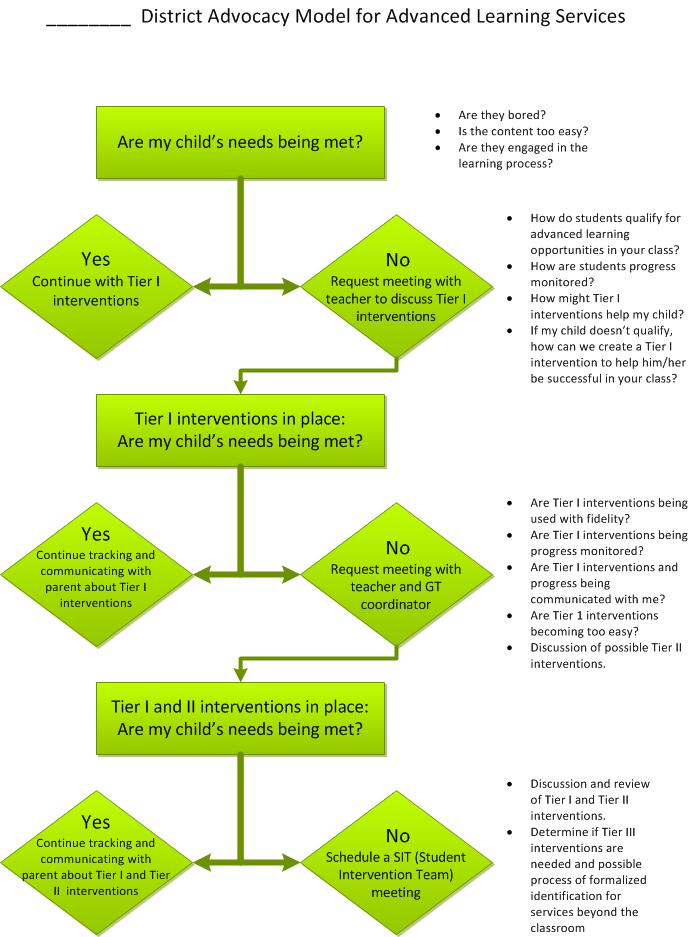
Parent Advocacy Model - Are my child's needs being met?

Well...here is a draft of what the model could look like...

Are we ready to embark upon the journey? Are parents ready to accept their role? Are teachers ready to hear what is needed?


As a parent, I know that a differentiated classroom is where my child will be most successful. If I am allowed to work with the teacher and help guide meaningful experiences, then we can all hold her accountable for growth. If she is not engaged or bored...I don't want to hear..."She just needs to do her work...If only she turned in her homework...If she just payed attention." 

If she is unengaged...there is a reason. Let's figure it out together and keep her moving forward. It might mean that the teacher needs to change her instruction in order to capture her engagement... and that's okay.

As a teacher, I know how overwhelming it can be to meet all the students' needs. I will never forget Pat (if you are out there Pat...let me know how you are doing)! He was a seventh grader in my language arts class who "hated" to write anything. After getting to know him and giving up some control of MY content...I asked him what he wanted to write about. He was a huge Metallic Fan and wanted to write about the band. I went home that night and created a plan to infuse my content into the course of his interest. Viola - he ended up writing a great paper on the band and learned through the process...WE BOTH DID! 

Differentiating in my classroom means engaging all students in the learning process...whatever their starting point...and holding everyone accountable for growth. At times that has meant I had to trust the student and parents and let them have the driver's seat. It is during these times that I have had to learn how to coach from the sidelines...and that is okay!

Just because a student doesn't qualify for "gifted and talented" services, doesn't mean that we ARE meeting their needs. Some students don't test well... and that is okay. Some students test great, but aren't interested in the pull-out reading group's project...and that is okay. Some students have a lot on their plate (sports, service projects) and want to pull back a little in other areas...and that is okay. Together...with parents...and student input...we have to help them figure out what is okay...and continually grow in their learning!

Just my two cents worth...
 

Sunday, January 27, 2013

My child's needs aren't being met - NOW WHAT?

Staring today...I am going to blog my journey... 

There is a definite need to change the way in which we identify and service "gifted education!" It can no longer be a "I'm in the gifted program...vs I don't qualify for the gifted program." We miss too much talent in our youth with this approach! We also put too much stress on our children when we say "you're smart!"

We need to help our children develop a growth mindset. That means we need to shattered the pendulum of gifted identification and SHIFT the paradigm.

 
So what does that look like within our school system? First of all, it means that our children deserve an educator who believes in the growth mindset and can differentiate the instruction our children receive on a daily...hourly...as needed basis! The pull-out (once a week...once a month) programs will not meet the needs of children who can aquire information quickly...or those who have a passion or interest in a specific subject or topic. 

We need an advocacy model for parents that begins with "Are my child's needs being met?" If the answer is "no," then a conversation with teacher/s need to take place to ask the following questions:

1. How are you pre-testing (pre-assessing) students to determine what skills they have already mastered?

2. How are you differentiating your instruction and how do you identify which students get those differentiated activities? - (Parents, make sure that this is not MORE but DIFFERENT!) - too many times a teacher will just "add on" assignments or activties rather than increase the difficulty level provided

3. How are students progress monitored in your class to ensure growth in learning for all students?

If a teacher cannot address these concerns, then I feel - as a parent - that I have a right to ask for another teacher who CAN do these things for my child. If I go to a doctor and he cannot provide me with services that will meet my needs, then I have a right to go see another doctor who will. Why do we have to accept a year worth of stagnant growth for our child if the classroom teacher is not strong in the skills of differentiating instruction for my child's needs...? 

Don't misinterpret my comments above. I am a teacher and believe that most of us have these skills, and we work hard every day to meet the individual needs of our students. However, just like any profession...there are those that do not want to change the pedagogy of their teaching to meet the 21st century learner. Students no longer need us to "teach" them content. If they want to learn something they can just go "google or youtube" it. For the majority of teachers, this was not how we learned. We needed to get information and knowledge directly from our teachers. 

Education is shifting to a "coaching" model. A teacher no longer needs to "teach" knowledge, but rather how to acquire it, evaluate it, and analyze it for validity. This does not mean we will never impart our knowledge onto our students, it just means that they now have the ability to aquire more knowledge on a specific topic than we do! Thus - my thoughts for today go FULL CIRCLE back to the importance of the GROWTH mindset!

Monday, January 21, 2013

Is your child gifted?


Okay...I am going to split my blogs into two from this day forward! I have two passions in life and one blog will be devoted to gifted education and Response to Intervention...the other blog will be devoted to K-8 computer science and programming! 

Please see Intervention Corner for great Response to Intervention resources!


I am currently working with my district on revising our "Gifted and Talented" identification and services. We are moving toward an inclusive Response to Intervention and Parent Advocacy model. The model revolves around one main question: Are my child's needs being met? 

The single most effective means of moving a student's learning path forward has to be based upon daily differentiated instruction based upon need and GROWTH! But more on that later...stay posted to this blog and follow along on the journey. 

Please forward to anyone who is interested in gifted education - both educators and parents!


Followers