Social Icons


Showing posts with label CCSS. Show all posts

Saturday, December 7, 2013

Hour of Code - FREE lesson plan!

One of the largest road blocks to having K-5 teachers implement computer programming skills is TIME! I have often heard my teachers saying "I just can't add more more thing to the day."

That's why I think that the success of incorporating computer science skills INTO the curriculum is essential! Currently, I am looking at the CCSS and the learning progressions. Using Scratch (www.scratch.mit.edu) - a FREE website, I am working on creating lessons that are aligned to the CCSS in ELA and math.

Please feel free to use the FREE resources and worksheets for the Hour Of code week - December 9th thru December 15th!  The worksheets take the Kindergarten student through the process of creating a holiday card through various screen shots.

http://scratch.mit.edu/projects/14804494/#player

Sunday, May 26, 2013

Google Literature Trips and More

Great uses of Google Apps in Education. The following video shows a group of students who used Google Apps - Doc, Spreadsheets, Gmail, Sites, Analytics and Forms to win $10,000 in the Scholastic/Lexus EcoChallenge!


Check out the following website for more Google Apps in Education ideas...including a Google Literature Trip assignment for Cold Mountain that was created for a group of high level 8th graders.

Saturday, May 11, 2013

How to Escape Education's Death Valley

Another video by my idol, Sir Ken Robinson. This is a must see video for all those who value the diversity of human creativity and achievement!

Finland - individualized learning - that's the ticket!

We have to give discretion back to the students and teachers!


This is the whole reason I have become a STRETCh Instructor - to create engaging and personalized choices for children in learning! Learning should be engaging and fun! Some of the best learning occurs when you don't even realize you're learning!

Please feel free to leave comments!

Sunday, April 28, 2013

Differentiated Instruction THE POWER!


Finding and encouraging teachers to use differentiated learning that can meet the needs of ALL students is essential! A Web Quest such as this can be personalized. For an advanced reading student, you could make the Pharaoh's Secret  a mandatory project out of 24 possible points. For artistic students, they might be required to complete a car-touche. The possibilities are endless!

Sunday, March 3, 2013

What our brightest students need and schools don't teach...


"In the next ten years, there will be about 1.4 million jobs in computer science and only 400,000 qualified graduates to fill those jobs." Thus, we need to enrich the education our students receive by differentiating and providing them with more opportunities to learn how to Code. 

So...how do we take the intimidation of coding (computer programming) out of the equation? 

Please see the following video that stresses the importance of computational thinking and learning how to code (program).  It REALLY is a powerful message and includes Bill Gates and a quote from Steve Jobs.


Please consider "liking" the STRETCh facebook page: goo.gl/r5foT
STRETCh - Striving To Reach Every Talented Child is about eliminating the ability of the school system to stall our children's education. Student's can do so much more than they are "allowed" to do in a school setting when we use whole group instruction. With technology, we can personalize learning and allow ALL student to grow and discover their strength areas. 

Wednesday, February 27, 2013

Student "tests-out" of a science unit...creates video game!

Bailey, a fourth grader who tested out of an up-coming unit on electricity and magnetism, decided to create a video game review for her classmates. Students used her game to review for their unit test by playing, evaluating and providing Bailey feedback.

What a great way to differentiate for the needs of a student who has already demonstrated proficiency on a topic of study. Allowing Bailey to work on her computational thinking skills and apply her content knowledge at a higher level, benefited not only her learning...but the learning of others as well.

Student scores on the post-test for the unit ranged from a low of 73% to a high of 100%. Needless to say, Bailey was one of the ten students to earn a 100%. In creating her game, she found she had to know the content forward...and backwards...


Monday, February 4, 2013

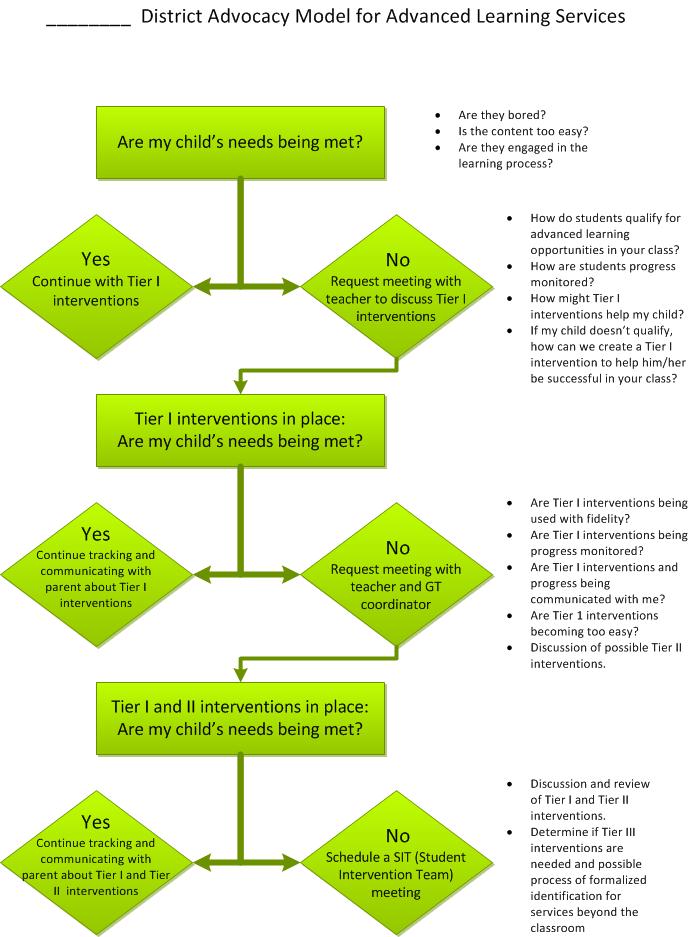
Parent Advocacy Model - Are my child's needs being met?

Well...here is a draft of what the model could look like...

Are we ready to embark upon the journey? Are parents ready to accept their role? Are teachers ready to hear what is needed?


As a parent, I know that a differentiated classroom is where my child will be most successful. If I am allowed to work with the teacher and help guide meaningful experiences, then we can all hold her accountable for growth. If she is not engaged or bored...I don't want to hear..."She just needs to do her work...If only she turned in her homework...If she just payed attention." 

If she is unengaged...there is a reason. Let's figure it out together and keep her moving forward. It might mean that the teacher needs to change her instruction in order to capture her engagement... and that's okay.

As a teacher, I know how overwhelming it can be to meet all the students' needs. I will never forget Pat (if you are out there Pat...let me know how you are doing)! He was a seventh grader in my language arts class who "hated" to write anything. After getting to know him and giving up some control of MY content...I asked him what he wanted to write about. He was a huge Metallic Fan and wanted to write about the band. I went home that night and created a plan to infuse my content into the course of his interest. Viola - he ended up writing a great paper on the band and learned through the process...WE BOTH DID! 

Differentiating in my classroom means engaging all students in the learning process...whatever their starting point...and holding everyone accountable for growth. At times that has meant I had to trust the student and parents and let them have the driver's seat. It is during these times that I have had to learn how to coach from the sidelines...and that is okay!

Just because a student doesn't qualify for "gifted and talented" services, doesn't mean that we ARE meeting their needs. Some students don't test well... and that is okay. Some students test great, but aren't interested in the pull-out reading group's project...and that is okay. Some students have a lot on their plate (sports, service projects) and want to pull back a little in other areas...and that is okay. Together...with parents...and student input...we have to help them figure out what is okay...and continually grow in their learning!

Just my two cents worth...
 

Wednesday, December 5, 2012

Learning Targets - Aim for Success!

Learning Targets - A must for educators!

www.scrappindoodles.com
In my role as K-12 Intervention coach, our district has been focusing on learning targets. In order to truly coach and model best practice, I had to take a dive into the CCSS in both math and ELA and I began to work on creating my own learning targets to use as models - in my spare time - in the evening :-)

This process has given me a global perspective of the content and process in teaching the CCSS. I used many resources to learn about learning targets and they can be found on my website: www.stretchinstructor.com

You will find information about North Carolina's "unpacking the standards" and other great resources!

Thursday, November 22, 2012

Global Education Conference 2012

Computational Thinking - Global Education Conference:

Last week I presented my "Because the Cat Goes Left" webinar for the world's largest free educational conference:http://www.globaleducationconference.com/ 

Incorporating computational thinking and computer programming into our K-8 curriculum must be a priority! I heard loud and clear from the participants in the audience that we need to start providing more training for our K-8 teachers in this area, so that they can incorporate these skills within their classrooms and within their existing curriculum. 

I am a firm believer that these skills do NOT have to be a separate class for our children. It needs to become a way of thinking!

If you would like to see ways in which you can incorporate into your teaching, along with concrete examples and rubrics, feel free to view the recording of the webinar.

If you would like to review the recording of the conference, please click the following link:

https://sas.elluminate.com/site/external/recording/playback/link/table/dropin?sid=2008350&suid=D.6B09C52F60690A44FF9C2812DCC0CF


Wednesday, November 7, 2012

CCSS Math - no wonder students get confused!

Working on alignment of math learning targets with the CCSS.  No wonder the students get confused...?


North Carolina unpacking the standards:

Before considering the relationship of decimal fractions, students express their understanding that in multi-digit whole numbers, a digit in one place represents 10 times what it represents in the place to its right and 1/10 of what it represents in the place to its left.

------------------------------------------------------------------------------------------------------------

Darke School District (Ohio):

I can look at a multi-digit number and determine that the digit to the left is 10 times greater than a given digit.

I can determine that in a multi-digit number, a digit to the right is 1/10 of the given digit.

------------------------------------------------------------------------------------------------------------

CCSS website:

CCSS.Math.Content.5.NBT.A.1 Recognize that in a multi-digit number, a digit in one place represents 10 times as much as it represents in the place to its right and 1/10 of what it represents in the place to its left.

------------------------------------------------------------------------------------------------------------

Align, Assess, Achieve: (flip book)

I can recognize that each place value to the left is 10 times larger in a multi-digit number.

I can recognize that each place value to the right is 1/10th as much in a multi-digit number.

------------------------------------------------------------------------------------------------------------

NOW - I realize that all are correct...but I highlighted what the students see. Is this what they are getting at when say "rigor?" Or is it just semantics...

Which way makes more sense to you?

Wednesday, October 24, 2012

STRETCh & Scratch

Well... last week was a whirlwind! My daughter celebrated her 9th birthday AND I conducted an ISTE webinar on STRETCh and Scratch - incorporating computer programming skills into the K-8 core curriculum.

To view the webinar, see the following link:

https://iste.adobeconnect.com/_a729309453/p35txgktvsb/

The computational thinking that went into the 6th grade Language Arts project above was incredible! After just 20 minutes of instruction and 4 class periods to work, student demonstrated their knowledge of verbs through the programming of their own video game! The engagement and focus of students throughout the four days was OUTSTANDING!

I have also created a website dedicated to K-8 computer programming: check it out here!

Tuesday, October 16, 2012

RtI - Response to Intervention

learning progression
In my new role as a K-12 Intervention Coach, I have seen many teachers frustrated and in tears over our jump into the proverbial RtI waters. In an effort to put the frustration into perspective, I came up with this visual of the building blocks needed in order to effectively deliver Tier 2 and 3 interventions. As you can see the 1st building block is an understanding of the CCSS - but not only at the grade level you teach. You really need to understand what comes before and after you...in order to put it into perspective. One you have a handle on the CCSS, then you need to break it down into bite sized chunks (aka: learning targets) for your students. THEN, you can move into formative assessment. How do I know when my children have achieved their learning target. Once I give the formative assessment, this will move into the 4th block of differentiation. I can then use my formative assessment to determine how I will differentiate for learners within my classroom. This is really the foundation for Level 1 of RtI. Once I have put these first four building blocks into practice, then I can work on collaborating with others around the level 2 & 3 interventions of RtI. 

Here is a website I have put together that is full of RtI resources!
https://sites.google.com/a/stretchinstructor.com/intervention-corner/


Followers